
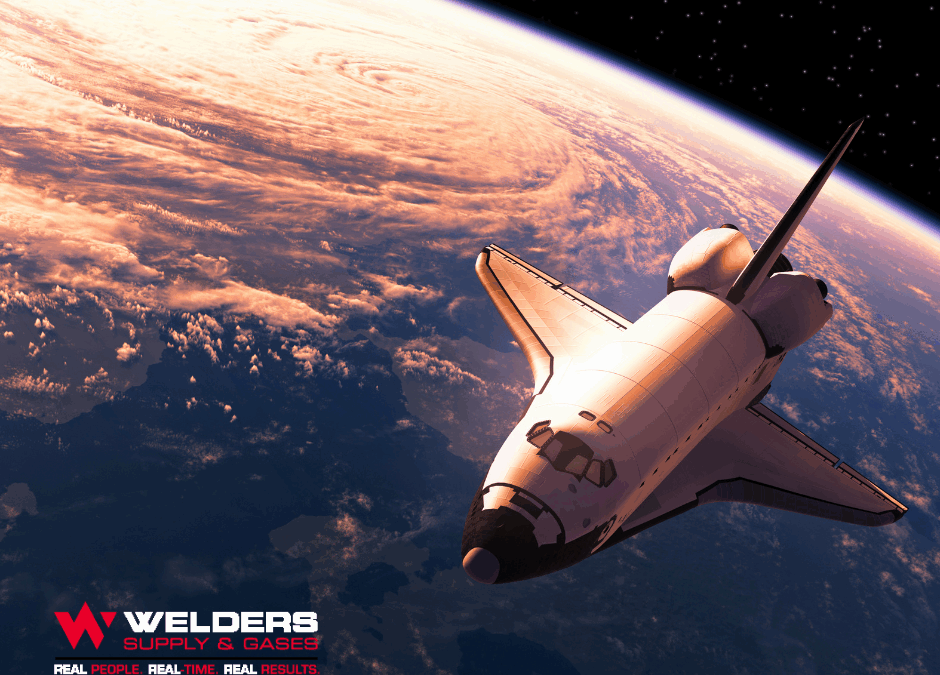
When Neil Armstrong took his first steps on the lunar surface in 1969, he stood on a spacecraft held together by thousands of precisely executed welds. Every rivet, joint, and seam of the Apollo 11 lunar module represented cutting-edge welding technology that had never been tested in such extreme conditions. Today, as we prepare for missions to Mars and beyond, welding remains the invisible backbone of space exploration.
This post explores how welding creates the durable, airtight structures that protect astronauts in the vacuum of space, the unique challenges engineers face when working in microgravity, and the innovative techniques pushing the boundaries of what’s possible in space construction.
Why Welding is Critical for Space Missions
Space presents the ultimate test for any material or construction technique. Spacecraft must withstand temperature swings from -250°F to 250°F, radiation bombardment, micrometeorite impacts, and the complete absence of atmospheric pressure. A single failed weld could mean catastrophic decompression and loss of life.
Creating Airtight Barriers
The most fundamental requirement for any crewed spacecraft is maintaining a pressurized environment. Welding creates seamless, gas-tight barriers that keep life-sustaining atmosphere inside while blocking the deadly vacuum of space outside. Unlike mechanical fasteners or adhesives, properly executed welds form molecular bonds that can withstand the constant stress of pressure differentials.
The International Space Station (ISS) exemplifies this principle. Its pressurized modules contain over 8,000 cubic feet of breathable space, all sealed by precision welding. Every window, hatch, and hull penetration relies on welded joints that have maintained their integrity for over two decades.
Structural Integrity Under Extreme Loads
Spacecraft experience tremendous forces during launch, orbital maneuvers, and planetary entry. Launch loads can exceed 4g, while atmospheric entry subjects vehicles to forces over 8g. Welded structures distribute these loads across the entire frame, preventing catastrophic failures that could occur with bolted or riveted joints.
The Space Shuttle’s aluminum fuel tank demonstrated welding’s load-bearing capabilities. Standing 15 stories tall and holding over 500,000 gallons of propellant, the tank’s welded construction handled the enormous stresses of launch while remaining light enough for orbital flight.
Weight Optimization
Every pound launched to space costs approximately $10,000 with current technology. Welded joints eliminate the need for heavy fasteners, brackets, and reinforcement plates required by other joining methods. This weight savings translates directly into increased payload capacity or extended mission duration.
Modern spacecraft use friction stir welding to join aluminum panels with joints that are actually stronger than the base material. This technique reduces structural weight by up to 20% compared to riveted construction while improving fatigue resistance.
Unique Challenges of Space Welding
Performing welding operations in space environments presents challenges that don’t exist on Earth. Engineers must account for microgravity, extreme temperatures, and the absence of atmospheric convection when designing welding procedures.
Microgravity Effects
In microgravity, molten metal behaves completely differently than on Earth. Without gravity to pull liquid metal downward, weld pools form spherical shapes that can create uneven penetration and porosity. Gas bubbles that would normally rise to the surface and escape instead remain trapped in the weld, creating weak points.
NASA’s welding experiments aboard the ISS have shown that surface tension becomes the dominant force governing weld pool shape. This requires completely different torch angles, travel speeds, and heat input parameters than terrestrial welding procedures.
Extreme Temperature Variations
Spacecraft surfaces can experience temperature swings of 500°F between sunlight and shadow. These thermal cycles cause expansion and contraction that stresses welded joints. Materials must be selected and welding procedures designed to accommodate this constant movement without cracking.
The Hubble Space Telescope has operated for over 30 years despite experiencing 5,800 thermal cycles annually. Its welded aluminum structure continues to maintain precise alignment thanks to careful material selection and stress-relieved welding procedures.
Outgassing and Contamination
In the vacuum of space, any volatile compounds will outgas and potentially contaminate sensitive equipment or obscure optical systems. Welding consumables must be specially formulated to minimize outgassing while maintaining strength and corrosion resistance.
Radiation Exposure
Cosmic radiation and solar particles can degrade materials over time, making long-duration missions particularly challenging. Welded joints must maintain their properties despite years or decades of radiation exposure.
Innovative Welding Technologies for Space
Space exploration has driven development of advanced welding techniques that offer superior performance in extreme environments. These technologies are now finding applications in terrestrial industries as well.
Friction Stir Welding (FSW)
Friction stir welding has revolutionized spacecraft construction by enabling high-quality joins without melting the base materials. A rotating tool generates friction heat while mechanically stirring the materials together, creating joints with superior fatigue resistance and minimal distortion.
NASA adopted FSW for the Space Launch System’s core stage, which contains the largest welded structures ever built for spaceflight. The 200-foot-tall liquid hydrogen tank uses FSW to join aluminum panels up to 0.5 inches thick, creating seamless cylindrical sections.
FSW offers several advantages for space applications:
- No filler materials required, reducing complexity
- Minimal heat input prevents warping of thin materials
- Excellent mechanical properties exceed parent material strength
- No porosity or hot cracking issues common with fusion welding
Electron Beam Welding (EBW)
Electron beam welding uses a focused beam of high-velocity electrons to create deep, narrow welds with minimal heat input. The process occurs in a vacuum chamber, making it ideal for materials that would oxidize during conventional welding.
The Mars rovers Curiosity and Perseverance both use electron beam welded components in their radioisotope thermoelectric generators. These units provide electrical power for years of operation in the harsh Martian environment.
Laser Welding
Laser welding offers precise control over heat input and weld geometry, making it ideal for joining dissimilar materials or creating complex joint configurations. The focused energy input minimizes the heat-affected zone, preserving material properties.
SpaceX uses laser welding extensively in manufacturing their Dragon capsule’s titanium grid fins. These components must withstand the intense heat and aerodynamic loads of atmospheric entry while maintaining precise control authority.
Solid-State Welding Processes
Several solid-state welding processes show promise for in-space manufacturing and repair operations:
Cold Pressure Welding: In the vacuum of space, perfectly clean metal surfaces can actually weld together through molecular adhesion when pressed together. This phenomenon has been observed on spacecraft and poses both opportunities and challenges for future missions.
Ultrasonic Welding: High-frequency vibrations create localized heating and plastic deformation, enabling joins without external heat sources. This technique could enable automated welding operations on robotic missions.
Welding in Iconic Space Missions
Examining specific space missions reveals how welding technology has evolved and enabled increasingly ambitious exploration goals.
Apollo Program
The Apollo spacecraft pushed welding technology to its limits. The command module’s heat shield attachment required over 3,000 individual welds, each critical for crew survival during high-speed atmospheric entry. The lunar module’s ascent stage used specialized welding procedures to join ultra-thin aluminum sheets, creating a pressurized cabin that weighed less than 5,000 pounds.
Space Station Construction
The ISS represents the largest welded structure ever assembled in space. While major components were fabricated on Earth, numerous welding operations have been performed in orbit for repairs and modifications. Astronauts have used portable welding equipment to fix ammonia leaks and install new structural attachments.
Mars Exploration Program
Every successful Mars mission has relied on advanced welding technology. The Mars Science Laboratory’s sky crane used friction stir welded aluminum structures to lower Curiosity rover to the surface. The Perseverance rover’s sample caching system employs precision welded titanium tubes designed to preserve Martian samples for decades until a future return mission retrieves them.
Commercial Spaceflight
Private companies like SpaceX and Blue Origin have revolutionized spacecraft manufacturing by applying automotive welding techniques to space vehicles. SpaceX’s Falcon 9 rocket uses friction stir welding for its aluminum structures and automated laser welding for stainless steel components on the Starship vehicle.
Future Applications and Innovations
As space exploration expands beyond Earth orbit, welding technology will play increasingly important roles in construction, manufacturing, and repair operations.
In-Space Manufacturing
Future missions will likely include welding operations performed in space to construct large structures that would be impossible to launch from Earth. Proposed applications include:
- Solar power satellites assembled in orbit from smaller components
- Deep space habitats built using materials mined from asteroids
- Interplanetary spacecraft constructed at orbital shipyards
Additive Manufacturing Integration
Combining 3D printing with welding opens new possibilities for in-space construction. Wire-fed additive manufacturing could build structural components layer by layer, with welding providing final joint integrity.
Robotic Welding Systems
Autonomous welding robots will enable construction projects without exposing human crews to radiation and other hazards. These systems must operate reliably for months or years without maintenance while adapting to changing environmental conditions.
Advanced Materials
New alloys and composites designed specifically for space environments will require specialized welding procedures. Shape memory alloys could enable self-repairing structures, while ceramic matrix composites offer improved thermal properties for high-temperature applications.
Preparing for Mars and Beyond
As humanity prepares for permanent settlements on Mars, welding will play crucial roles in construction and maintenance operations. The Martian environment presents unique challenges including dust storms, temperature extremes, and a thin carbon dioxide atmosphere.
Future Mars missions may include welding equipment for:
- Constructing habitats from locally produced materials
- Repairing spacecraft and equipment
- Building manufacturing facilities for return missions
The welding techniques developed for these missions will eventually enable construction of permanent bases and eventually cities on other worlds.
The Invisible Foundation of Space Exploration
Welding may not capture headlines like rocket launches or planetary discoveries, but it forms the invisible foundation that makes space exploration possible. Every successful mission depends on thousands of precisely executed welds that hold spacecraft together through the most extreme conditions imaginable.
As we look toward an era of permanent space settlement, welding technology will continue evolving to meet new challenges. The techniques being developed today for Mars missions will eventually enable construction of space elevators, orbital cities, and interstellar spacecraft.
The next time you see images from the ISS or news of a successful Mars landing, remember the skilled welders and engineers whose invisible work made those achievements possible. In the unforgiving environment of space, there are no second chances – every weld must be perfect, and the consequences of failure are measured not just in dollars, but in human lives and the advancement of our species among the stars.

